
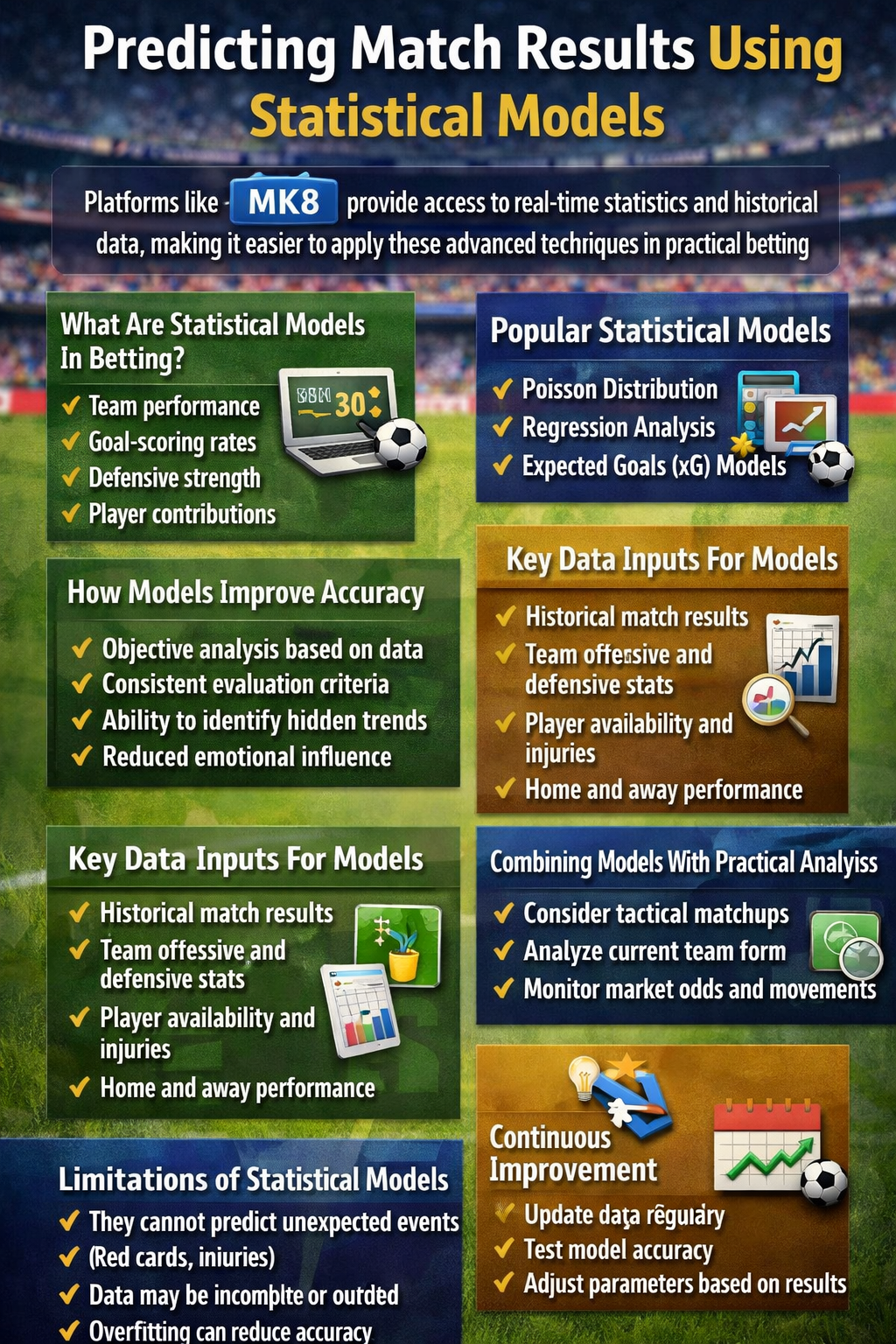
Predicting football match results using statistical models has become one of the most effective approaches in modern sports betting. Instead of relying on intuition or basic analysis, bettors can use data-driven models to estimate probabilities and identify value opportunities. Platforms like MK8 provide access to real-time statistics and historical data, making it easier to apply these advanced techniques in practical betting scenarios.
📊 What Are Statistical Models In Betting?
Statistical models use mathematical formulas and historical data to predict match outcomes. These models analyze patterns and relationships between variables such as:
- Team performance
- Goal-scoring rates
- Defensive strength
- Player contributions
By processing this information, models generate probability-based predictions rather than guesses.
⚽ Popular Statistical Models
Several models are commonly used in football prediction:
✔ Poisson Distribution
Used to estimate the probability of goals scored in a match.
✔ Regression Analysis
Identifies relationships between different variables to predict outcomes.
✔ Expected Goals (xG) Models
Evaluate the quality of scoring chances to predict performance.
These models help bettors make more informed decisions.
📈 How Models Improve Accuracy
Statistical models provide advantages such as:
- Objective analysis based on data
- Consistent evaluation criteria
- Ability to identify hidden trends
- Reduced emotional influence
This leads to more reliable predictions over time.
🔍 Key Data Inputs For Models
To build effective models, you need accurate data:
- Historical match results
- Team offensive and defensive stats
- Player availability and injuries
- Home and away performance
High-quality data is essential for accurate predictions.
⚠️ Limitations Of Statistical Models
While powerful, statistical models have limitations:
- They cannot predict unexpected events (red cards, injuries)
- Data may be incomplete or outdated
- Overfitting can reduce accuracy
Bettors should use models as a tool, not a guarantee.
💡 Combining Models With Practical Analysis
The best approach is to combine statistical models with real-world analysis:
- Consider tactical matchups
- Analyze current team form
- Monitor market odds and movements
This combination improves decision-making.
🔄 Continuous Improvement
To stay effective, bettors must refine their models:
- Update data regularly
- Test model accuracy
- Adjust parameters based on results
Continuous improvement is key to long-term success.
🧠 Think Long-Term
Statistical models are most effective when used consistently over time:
- Focus on probability, not certainty
- Accept short-term losses
- Aim for long-term profitability
Patience is essential when using data-driven strategies.
✅ Conclusion
Predicting match results using statistical models offers a powerful advantage in sports betting. By leveraging data, understanding probabilities, and combining models with practical insights, bettors can significantly improve their accuracy. Stay disciplined, keep refining your approach, and focus on long-term success rather than short-term outcomes.
